

Build More Connected, Confident Learning Communities
ESTE helps identify innate traits, leading to success in the classroom by building confidence, communication, and community.
Ready to explore ESTE for your school or district? Request Information
ESTE for Schools, Classrooms, and Communities
-
Team Building
Build a shared leader-player language for communication and decision-making.
Administrators can align departments around roles that reflect how educators actually think and teach.
Stronger clarity and connection across leadership flows into better staff collaboration.
-
Educator Support
Discover your ESTE Avatar and learn how your thinking style shapes your classroom approach.
Build confidence in curriculum design, student interaction, and communication with caregivers.
Use self-awareness to reignite purpose and reduce burnout.
-
Student Empowerment
Help students identify their strengths and values.
Equip them with language to communicate, collaborate, and pursue STEAM interests.
Promote long-term engagement and confidence in their potential.
-
Community Development
Build parent, mentor, and community networks around the ESTE framework for deeper support.
Shared understanding helps everyone—from staff to families—feel heard, valued, and interconnected.
Create ongoing, talent-aligned support systems for young learners.

A Clear Framework for
Growth, Connection, and Career Development
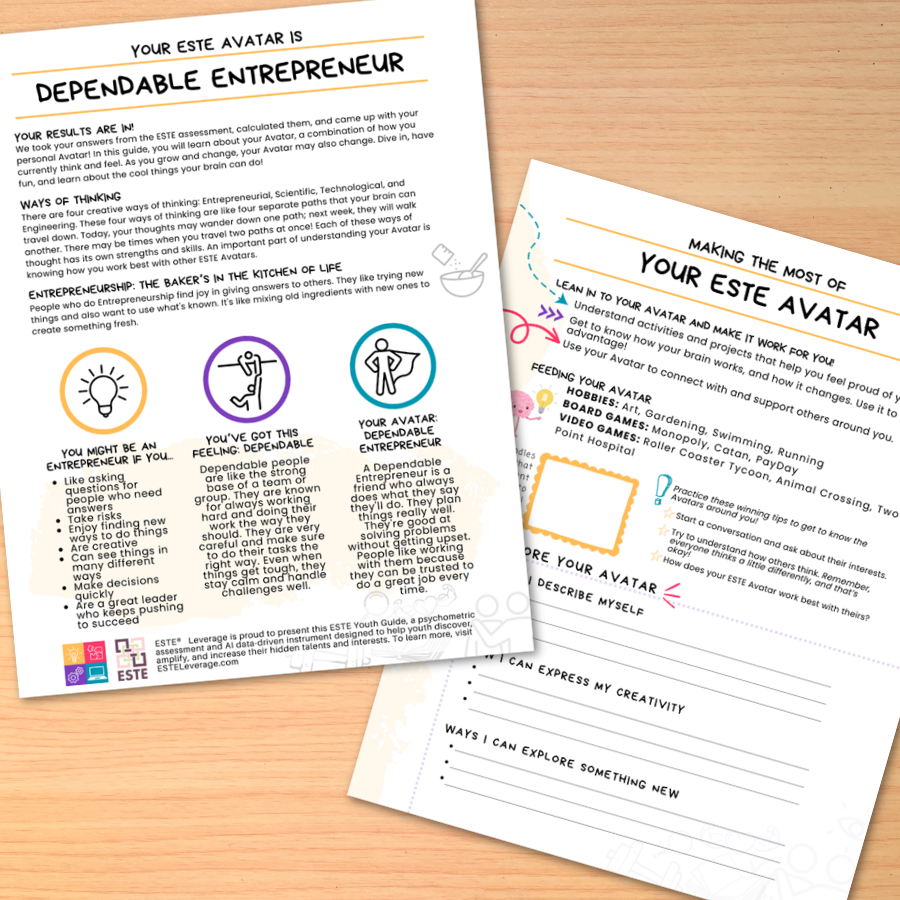
The ESTE Self-Assessment takes about 20 minutes and generates a personalized Avatar based on how a person thinks and communicates. With 80 possible Avatar profiles—drawn from four Creative Thinking Modes and twenty Creative Feeling Modes—users receive clear insight into how they approach problem-solving, collaboration, and decision-making.
In educational settings, this insight supports practical outcomes. Teachers use their results to improve classroom leadership, team communication, and alignment with professional goals. Students use theirs to better understand how they learn, set personal goals, and stay engaged in school, extracurriculars, and career exploration.
Schools and districts use ESTE to build shared understanding across classrooms, grade levels, and teams. Staff gain a common language for identifying student needs, designing support strategies, and strengthening communication. ESTE becomes a tool for building a learning culture where everyone—from students to staff—feels equipped, connected, and motivated to grow.
“91% of students with high self-awareness and confidence report feeling prepared for the future.”
-
The way you think, solve problems, and connect with others is a real strength. ESTE helps you describe those abilities in ways that apply to both school and career. This language is useful for children developing confidence and for adults re-evaluating what they bring to their work and relationships.
-
Your Avatar reflects how you think and how you connect. It is based on a combination of your Creative Thinking Mode and your Creative Feeling Mode. This profile may shift as your experiences grow, helping you understand yourself in new ways throughout life.
-
Creative Thinking Modes show up in everyday choices, decisions, and conversations. Some people focus on vision and possibilities, others on logic, systems, or discovery. These patterns exist across all settings and become easier to recognize with practice.
[Link to ESTE Modes section] -
Skills and strengths are not fixed. They develop through reflection, effort, and experience. ESTE supports this growth by giving people of all ages tools to notice their progress and build confidence over time.
-
Self-doubt often starts when people are unsure how to describe what they do well. ESTE provides clear language and examples that help both students and professionals recognize their abilities. This clarity makes it easier to speak up, stay motivated, and pursue meaningful goals.
-
When someone feels pressure to represent a group or prove themselves, it can affect how they perform. ESTE creates a strong foundation of self-awareness that helps users stay focused on their strengths. Knowing how you work best brings a sense of control and calm in moments that might otherwise feel uncertain.
-
Taking ESTE as a family opens up conversations that may not happen otherwise. Parents and children begin to understand each other’s differences as strengths. This shared understanding makes everyday interactions smoother and strengthens the connection between family members.
One Quick Assessment, Hundreds of Applications
Your Experience with ESTE begins with the ESTE Self-Assessment, completed online and takes about 20 minutes.
Your results will show your personalized Avatar, combining your preferred Creative Thinking and Creative Feeling Modes. The four Creative Thinking Modes are Entrepreneurship, Science, Technology, and Engineering, which relate to task process and outcome. The 20 Creative Feeling Modes identify how you communicate and work with others in a way that motivates you and the recipient.
Supporting Educators and Students Where It Matters Most
68% of teachers report higher job satisfaction when supported in personal development (Learning Policy Institute, 2020). ESTE builds clarity and self-awareness to empower educators regardless of classroom size.
Classrooms with strong SEL see 13% academic gains (CASEL, 2023). ESTE offers insight into thinking styles to enrich empathy, trust, and participation.
Students with self-awareness are 3.5× more likely to stay engaged (Panorama, 2021.) ESTE helps students understand how they learn and collaborate—reducing dropout from STEAM pathways.
Teachers who feel supported in their personal development are 68% more likely to report job satisfaction and sustained engagement (Learning Policy Institute, 2020). ESTE supports educator growth by providing insight into personal strengths and communication styles, leading to more meaningful engagement in the classroom and school community.
Youth with self-advocacy coaching show a 32% increase in academic resilience and problem-solving. (National Center for Learning Disabilities, 2016). ESTE supports self-advocacy by helping students identify and articulate their natural strengths, learning preferences, and communication style with confidence.



What Makes ESTE Different?
Backed by Research
Grounded in proven models and published by APA and SEPA, ESTE is tailored for real-world career insight.
Bias-Aware by Design
Crafted to reduce bias and honor your real-life context.
More Than a Type
Understand your creative strengths and emotional lens—your ESTE Avatar reflects both.
Built to Evolve
Captures who you are today—and grows with you over time.
Built by Experts
Created by educators, developers, and lifelong learners who believe in your potential.
The ESTE Paradigm
ESTE promotes growth by supporting self-awareness, relationship-building, and community strength.
Empower Educators & Inspire Students

The abundance of information and tools available to educators can be overwhelming, making it difficult to identify solutions that support students' natural skills and traits.
As a result, helping students find their passions can get lost in the day-to-day requirements of educating a diverse collection of students. Immediate metrics are met but at a potential long-term cost.
Students who feel connected to their educators, inspired by the topics, and passionate about subjects may be better prepared for extracurricular engagement, college, and future careers.
The ESTE Self-Assessment was designed to solve some of the STEAM attrition that educators see as students progress in their education, by understanding the student at a fundamental level. Attrition in STEAM is especially high in girls who may be inadvertently subjected to gender bias or don’t see themselves reflected in their fields of interest. Educators who are empowered with the knowledge of their own Creative Thinking and Creative Feeling Modes can begin to bridge the gap for their students and inspire them to stick with STEAM as they grow into adults.

“If you give kids opportunities to nurture what they love, they will thrive.”
— Jose Duenas
Balboa Middle School Teacher | Association Student Body Director, Electives Department Chair
California Association of Directors of Activities 2021 Jack Moore Award Recipient
A Foundation for
Career Exploration and Lifelong Learning
Career development begins with self-awareness. Students who understand how they think, what they enjoy, and how they connect with others, they are more prepared to make decisions with confidence and purpose. ESTE supports educators and community leaders by offering tools that help individuals at every level recognize their strengths, interests, and values.
Here are some of the ways ESTE encourages development across educational settings:
Career exploration is more effective when rooted in personal insight. Identifying how a student processes information and engages with the world helps guide academic and career planning.
Everyday behaviors often reflect valuable skills. Creativity, problem-solving, organization, and communication show up in ways that matter both in the classroom and beyond.
Confidence grows when students have language to describe how they contribute. This clarity supports stronger classroom participation and long-term engagement.
Beginning early builds motivation and adaptability. Students who see themselves clearly are more likely to stay connected to their goals and pursue new opportunities with curiosity.
Educators benefit from this insight, too. Understanding your own ESTE profile can strengthen communication with colleagues, deepen classroom relationships, and support leadership growth.
Learning communities thrive with a shared framework. When educators, students, and families speak a common language about strengths and thinking styles, collaboration becomes more effective and relationships grow stronger.
Everyone Thinks Differently, And That’s Our Strength
In every school and classroom, people approach challenges in different ways. These thinking styles shape how educators plan lessons, lead teams, respond to students, and work together. The ESTE Framework brings clarity to these patterns by helping individuals understand how they think, communicate, and collaborate.
Your ESTE Avatar highlights your natural approach to problem-solving and leadership. Whether you lean toward Entrepreneurship, Science, Technology, or Engineering, your thinking style influences how you contribute to your school culture and connect with your students. With greater awareness comes greater confidence—and the ability to support others with clarity, purpose, and authenticity.

-

Entrepreneurs are idea-makers who see opportunity where others see uncertainty. They enjoy imagining what could be and are often the ones to start bold new projects. In classrooms, they bring energy and bold thinking; in the workplace, they are the vision-setters who lead new initiatives and rally others around possibility.
-

Scientists are curious minds who love to ask questions and dig deep for answers. They enjoy exploring ideas, testing theories, and discovering how things really work. In teams, they offer thoughtful insight and steady analysis; in professional settings, they thrive in research, strategy, and roles where knowledge and accuracy matter.
-
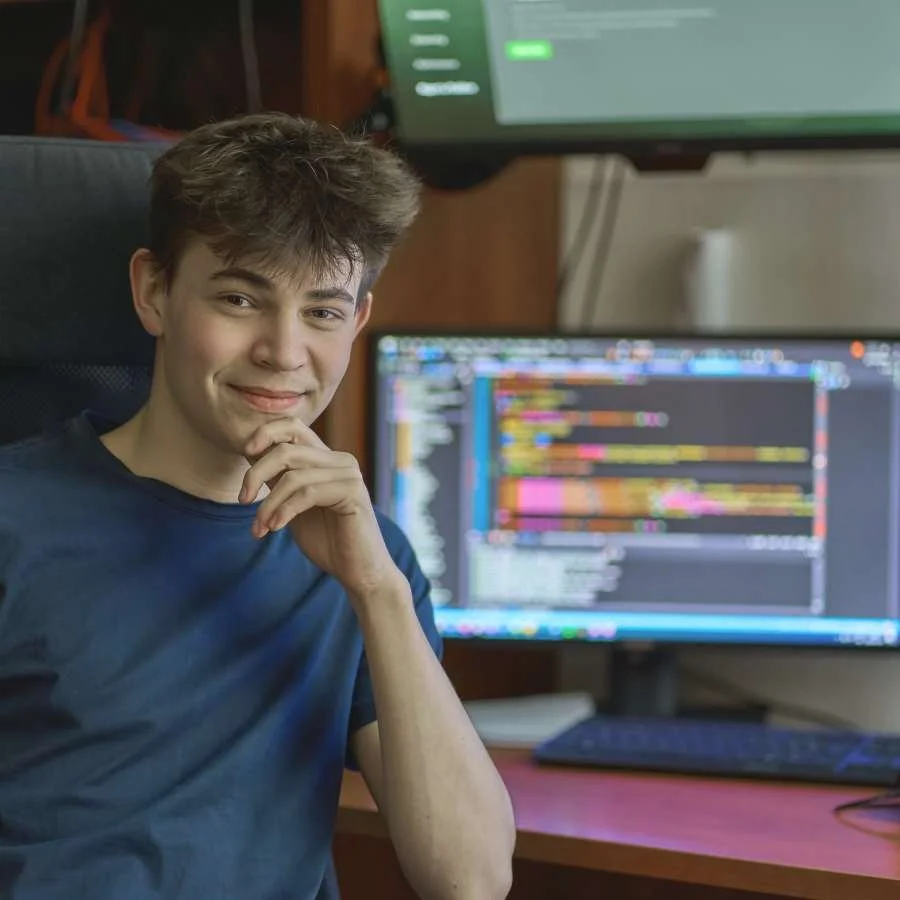
Technologists love figuring out how systems work and how they can be improved. They are natural organizers and thinkers who notice patterns and bring structure to complex problems. In classrooms, they build frameworks for group success; in their careers, they design efficient systems, refine processes, and bring order to chaos.
-
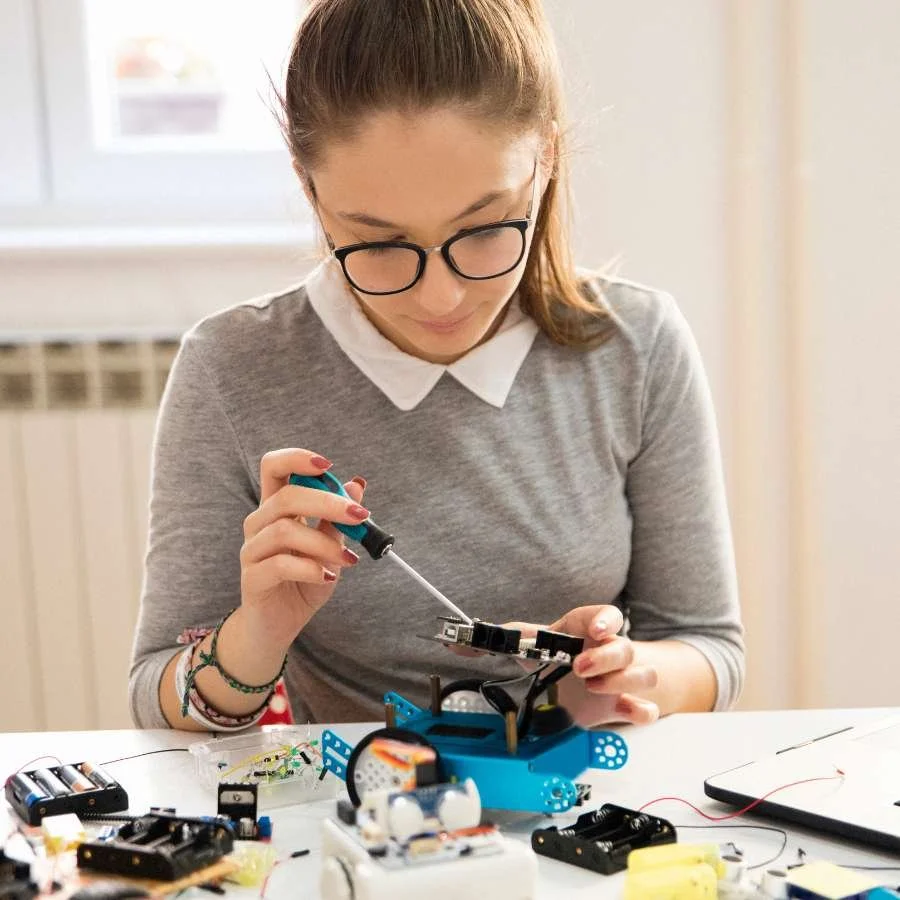
Engineers enjoy solving real problems in clear, step-by-step ways. They think carefully, plan ahead, and work well with others to make things that last. In school, they help others stay grounded and on task; in the workplace, they thrive in project management, operations, and roles that turn ideas into tangible results.
General FAQ
-
ESTE Leverage has several products offered with the Self-Assessment. The Professional Affirmation Roadmap starts at $75, Youth Affirmation Roadmaps start at $50, and High School Pathfinder Reports start at $75. We are proud to offer bundle pricing for organizations purchasing bulk licenses.
-
After you’ve made your purchase, you can access the ESTE Self-Assessment at your convenience. When you’re ready, follow the link in your email. The self-assessment will take approximately 15-20 minutes.
Immediately following your assessment, you will learn about your Avatar. Within one business day, you will receive an email with your personalized Professional Affirmation Roadmap and Resource Guide. -
The ESTE Framework is the idea that each person has natural tendencies toward the application of Entrepreneurship, Science, Technology, and Engineering.
The Framework relates each of these four Creative Thinking Modes by breaking down their preferences toward process and outcome.
For example, an Entrepreneur enjoys exploring to find solutions for others. The end product for the Entrepreneur is Innovation.
-
We love to connect with the ESTE Leverage community! If at any time you have a question or simply want to chat, feel free to contact us!
-
ESTE Leverage offers both in-person and virtual meetings to discuss assessment results. This flexibility ensures that you can choose the format that best suits your needs and geographic limitations.
For information and scheduling, please contact us!
Educator FAQ
-
Acknowledging and developing an understanding of the Creative Thinking and Feeling Modes of yourself and others can improve communication and collaborative efforts. This awareness grows into skills that foster empathy and team member appreciation by highlighting diverse strengths and approaches within a group.
-
Educators and Administrators gain invaluable personal insight that enables them to access their internal motivators and processes and then apply them to daily interactions and projects.
In a practical setting, this looks like an administrator who is able to work efficiently with their team by tapping into each person’s natural strengths.
As an educator, learning about your personal Avatar may equate to understanding, connecting, and inspiring students who previously struggled with a subject. -
No, the assessment itself does not directly count as Continuing Education units required by professional boards. However, related workshops or courses offered by ESTE Leverage that use the assessment as a foundation might qualify, depending on the accrediting organization.
-
Yes, ESTE Leverage has a Youth Affirmation Roadmap Self-Assessment that is available for middle-school students.
The Youth Self-Assessments are designed to help educators and students boost team communication and inspire an early love of STEAM concepts through an introductory understanding of Creative Thinking and Feeling Modes. Educators are able to enroll their classrooms through an agreement between ESTE Leverage and the school.